What we do, and where.
For years now, we have been running programmes in Lagos and Ogun State that meet people where they are. School fees for children who would otherwise drop out. Meals for widows who would otherwise go hungry. Clean water for communities where it is scarce. Each programme grew from a conversation with someone who needed help, and each one is still growing because more people are joining the work.
The scale
62%
of Nigeria's population lives below the poverty line. That is 141 million people, and the number is climbing, not falling.
In Lagos and across Ogun State, where we work, poverty is not a background condition. It is the daily reality of mothers stretching N50,000 across a month for a family of five, of widows with no income and no fallback, of children who start a school term and quietly stop attending because the uniform wore out and there was no money to replace it.
These are not edge cases. They are the majority. And the majority of them are connected to each other, living in the same streets, attending the same churches and mosques, buying from the same markets. Community is already there. What we do is activate it, point resources into it, and build something consistent enough that people can rely on it.
Keeping children on the register.
Twenty-eight million Nigerian children have no access to formal schooling, and 79% of them come from households in poverty. The barrier is almost never the child. It is almost always the money. Government school fees are nominally low, but uniforms, textbooks, exercise books, shoes, bags and stationery stack up into amounts that are out of reach for families already at the edge. A child without a uniform gets sent home. A child without books falls behind. Quietly, without drama, they stop going.
Every year, we go directly into government schools in Lagos and Ogun State and cover what makes the difference between a child staying in school and a child leaving it. Uniforms. Textbooks. Exercise books. Basic sanitation supplies. We return to the same schools each year, so teachers and communities know the work is consistent and call when something is needed. It is a recurring commitment to specific communities that have learned they can count on it.
Schoolchildren in uniform gathered outside during a school visit.
Food that arrives on a schedule.
More than half of Nigerian households do not have reliable access to adequate food. In the communities we work in, this means families eating one meal a day when the money runs out mid month, widows with no household income managing on whatever neighbours and relatives can spare, and children going to school on empty stomachs. Hunger is a slow, ordinary, grinding presence for millions of people who are otherwise working, raising children and participating in their communities.
Ease Monthly Meals addresses this directly through food stamps for widows, distributed every month in the communities we work in. It does not solve widowhood. It solves the month. Friday Ease Meals runs weekly across Lagos, because food insecurity does not take weekends off, and showing up at the same places every Friday builds trust in a way that occasional drives never do. Our monthly food boxes extend this further, delivered straight to a family's door.
Three girls holding their meal packs after a food distribution.
Showing up for the holy month.
Every year during Ramadan, we run a dedicated feeding programme across Lagos that reaches families who would otherwise go without. Ramadan is a time of community and generosity across Nigeria, and for families in poverty it is also a time when the gap between what the season expects and what is possible becomes sharply visible. Breaking fast requires food. Sahur requires food. For a family already stretched, the additional demand lands on top of an already impossible budget.
This is one of the most direct things we do. Food, prepared and distributed, to people in the communities we work in, during the month when they most need to know that someone is thinking of them. It runs every year, and it reaches more people each time. If you would like to contribute to this year's programme specifically, please get in touch.
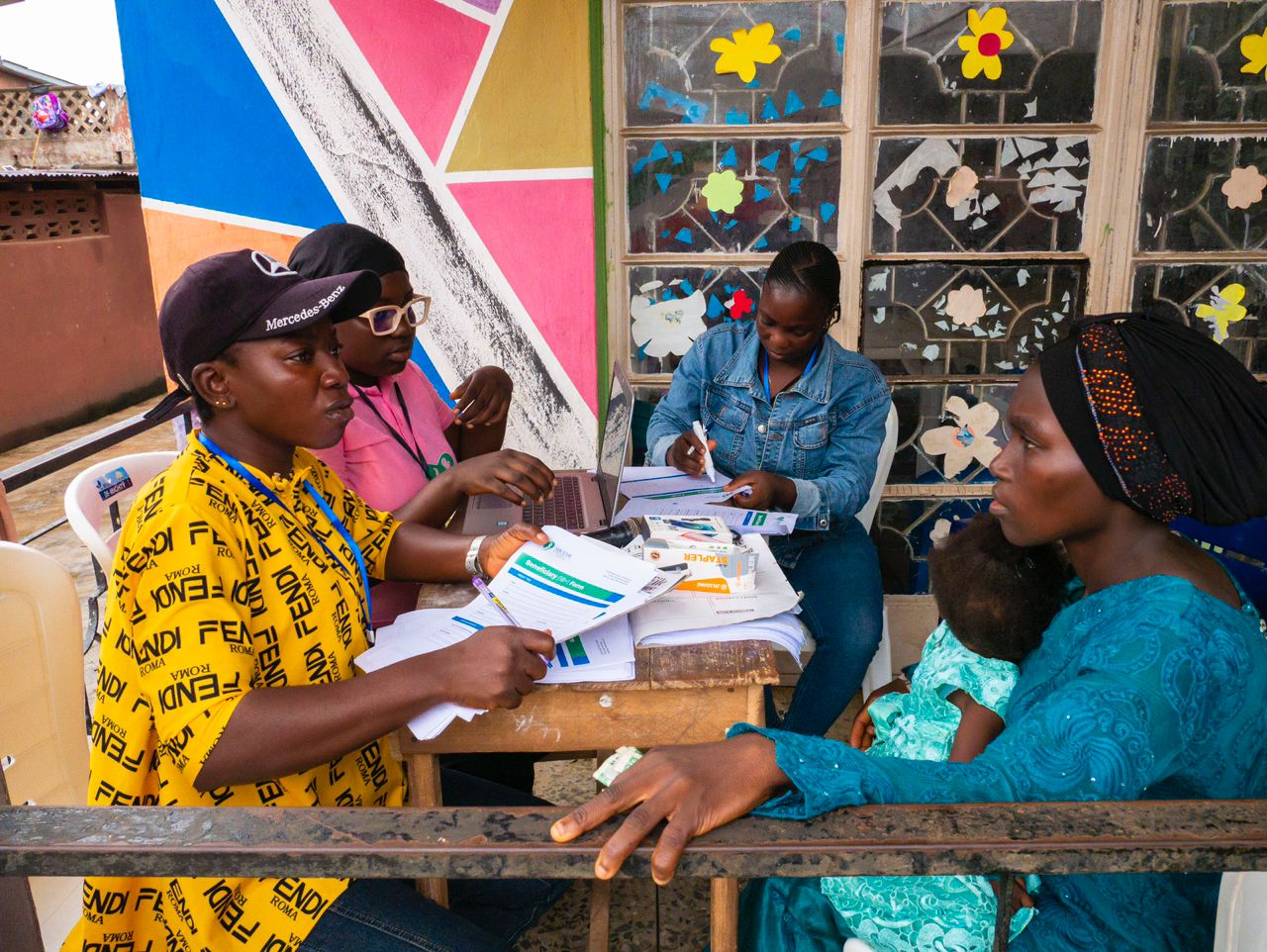
Meal packs being shared with children during Ramadan outreach.
The baseline beneath everything else.
Access to clean drinking water varies enormously across Lagos and Ogun State. In slum communities and informal settlements, where 37 million Nigerians live, reliable clean water is not a given. Ease Quench provides sachets of clean drinking water, bottled water and fruit juice during outreach events and feeding programmes, and at the larger scale works toward building boreholes for communities where clean water is a structural problem rather than an occasional one.
Clean water is not a luxury. It is the baseline beneath which nothing else, health, school attendance, productivity, dignity, can function properly. We treat it that way, not as an add on to other work but as a fundamental part of what community care looks like in practice.
An example of a bag (school supplies) we distribute to schools.
One donor, one named child.
Every quarter, we go into schools and match donors directly to a specific child. Not a category of child, not a generalised cause, but one named person whose school fees, food and essential needs are covered by one donor for as long as the match holds. The child knows someone chose them. The donor receives updates on the child they are supporting. The distance that usually sits between someone giving and someone receiving collapses into something more direct.
Sustained support changes outcomes in ways one off donations cannot. A child who is fed and equipped for one term and then loses that support is better off than a child who received nothing, but they are not the same as a child who knows next term is also covered, and the term after that. Consistency is what allows a child to plan, to stay in school, and to believe that the investment is worth making.
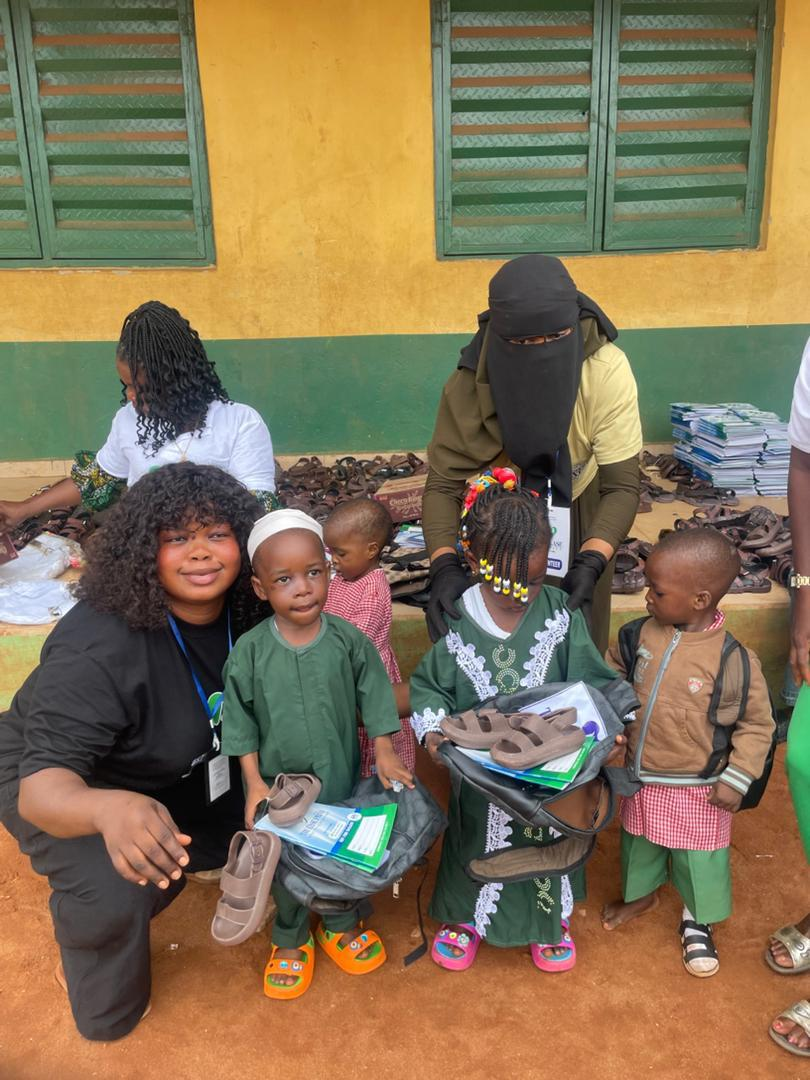
One of our annual school visits
Reducing the conditions that make dependency necessary.
Poverty is not evenly distributed within communities. Women, and particularly mothers and widows, carry a disproportionate share of it. Our outreach and women's empowerment programme works directly with women in Lagos and Ogun State, providing skills training, resources and the kind of practical support that builds toward economic independence rather than just managing immediate crisis.
A woman with a skill and a small market for it is in a fundamentally different position from a woman with neither. This programme is not about creating dependency on the charity. It is about reducing the conditions that make dependency necessary in the first place.
A women's empowerment cohort during a training session.
None of this happens without people physically present.
Showing up to schools and communities, distributing food, building relationships, following up. Our volunteer network is made up of people who live in the communities we work in, who understand them, and who have chosen to put their time into making this work function. If you are based in Lagos or Ogun State and want to be part of what is being built here, the volunteer page has everything you need to get started.
In their own words.
Real stories from the people we work with.
Be part of what is next.
Every programme on this page can reach more people. The only question is how many more. Thank you for being one of the reasons it keeps growing.